Comfort in clouds
as I was making my way to the exposed flanks of mt Shani, between earth and sky, I started reflecting on a life long relationship with clouds.

When I was much, much younger, I had this odd vision in my head. I remember asking my mother if we could trap a cloud in a jar. Maybe we could go to the mountains one day and put a jar out there to try to capture a cloud and keep it in there, because I wanted it close to me. I wanted it to be near me, to touch it, to observe it. I even thought about whether it was possible to create indoor lightning strikes. I tried to collect whatever kids' science booklets and experiments I had to figure out. I can remember vividly that my mother went along with this conversation. She told me that perhaps a cloud is thinner than I think. It disperses. It’s not cotton. It’s not something we can grab and touch.
Looking back, I can't recall exactly how it started. I can't recall what ignited this inner desire of liking to watch clouds and finding comfort when seeing them. All I remember is that I had this small booklet in French called Cent Orages Faciles à Prévoir around the age of nine or ten. Back then, we lived a couple of hundred meters above sea level, and our balcony overlooked Beirut, the airport, and the sea. I remember clearly watching the first waves of clouds and thunder approaching from the southwest of Beirut above the sea, trying to observe how the clouds formed. Guided by my small booklet, I started to self-learn, observe, make links, and learn the names.
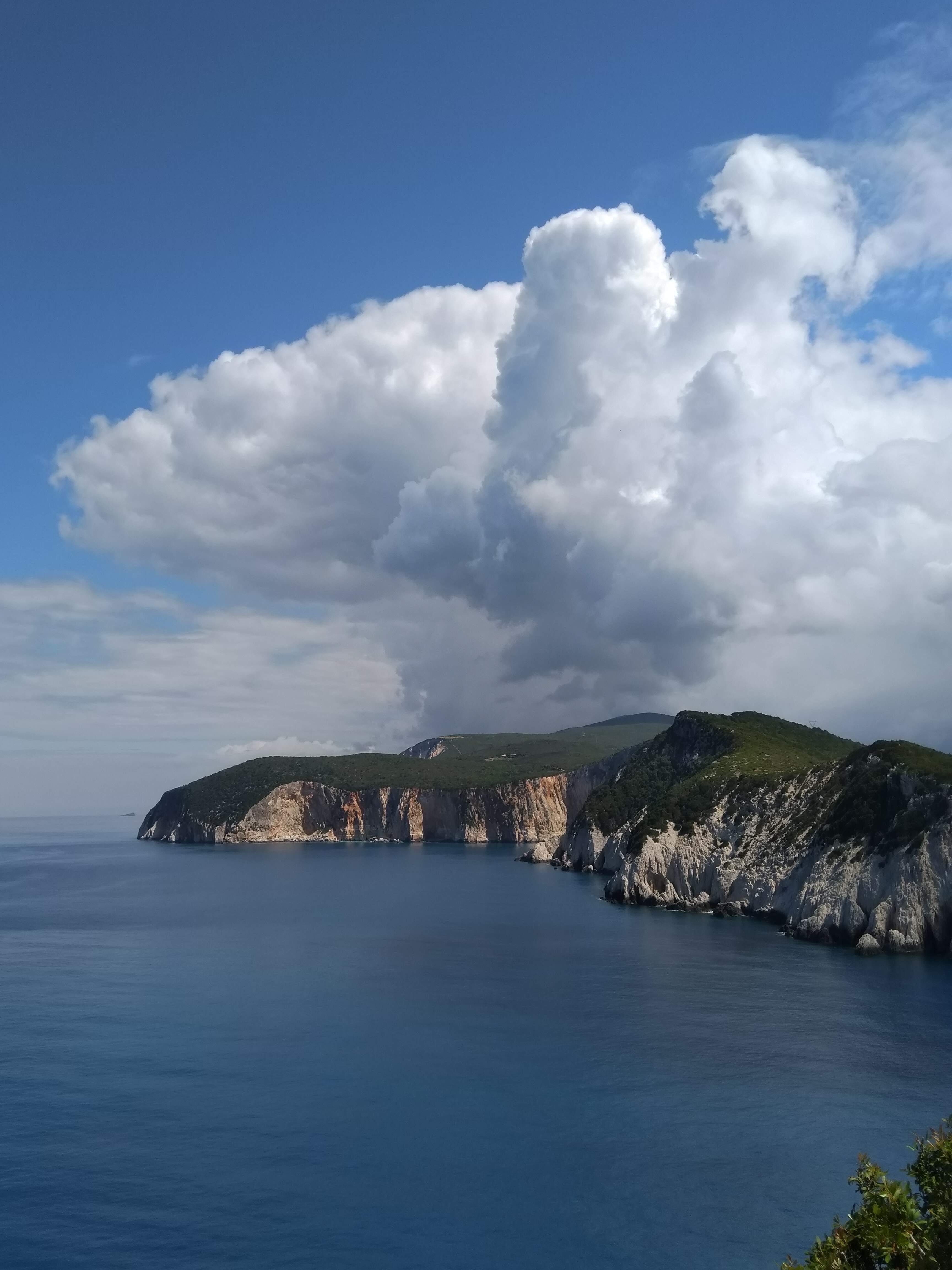
Photo: a beautiful cumulonimbus above Lefkada Island, Greece.
When late September and early October approached, it brought some sort of calmness, because I knew it was the month of beautiful clouds. We do not get much summer rain in Lebanon and not seeing clouds for a few months always affected me negatively. I don't know if it's because I'm a September boy, but something about this change of weather felt good; cooler wind, the approach of the first rain clouds from the south above the sea.
I can remember one October at midday when I saw a beautiful wall of clouds approaching from above the sea, from the southwest, with a warmer wind front. As the first clouds started to cover the blue skies, the ambience became dimmer. I could feel the presence of silence in the air, bringing an abrasive sensation, like waiting for something to happen.
I recall the first lightning strike somewhere near the airport, some others over the sea, and this lightning kept coming closer, lasting a few good hours. I enjoyed every single moment, watching how the low-pressure system approached and evolved. I tried to count the difference between the lightning and the sound of thunder to estimate the distance, just like the book suggested. The formula is simple: distance in kilometers is roughly the number of seconds between the lightning flash and the thunder divided by three. It was fascinating to see theory match reality in real time.
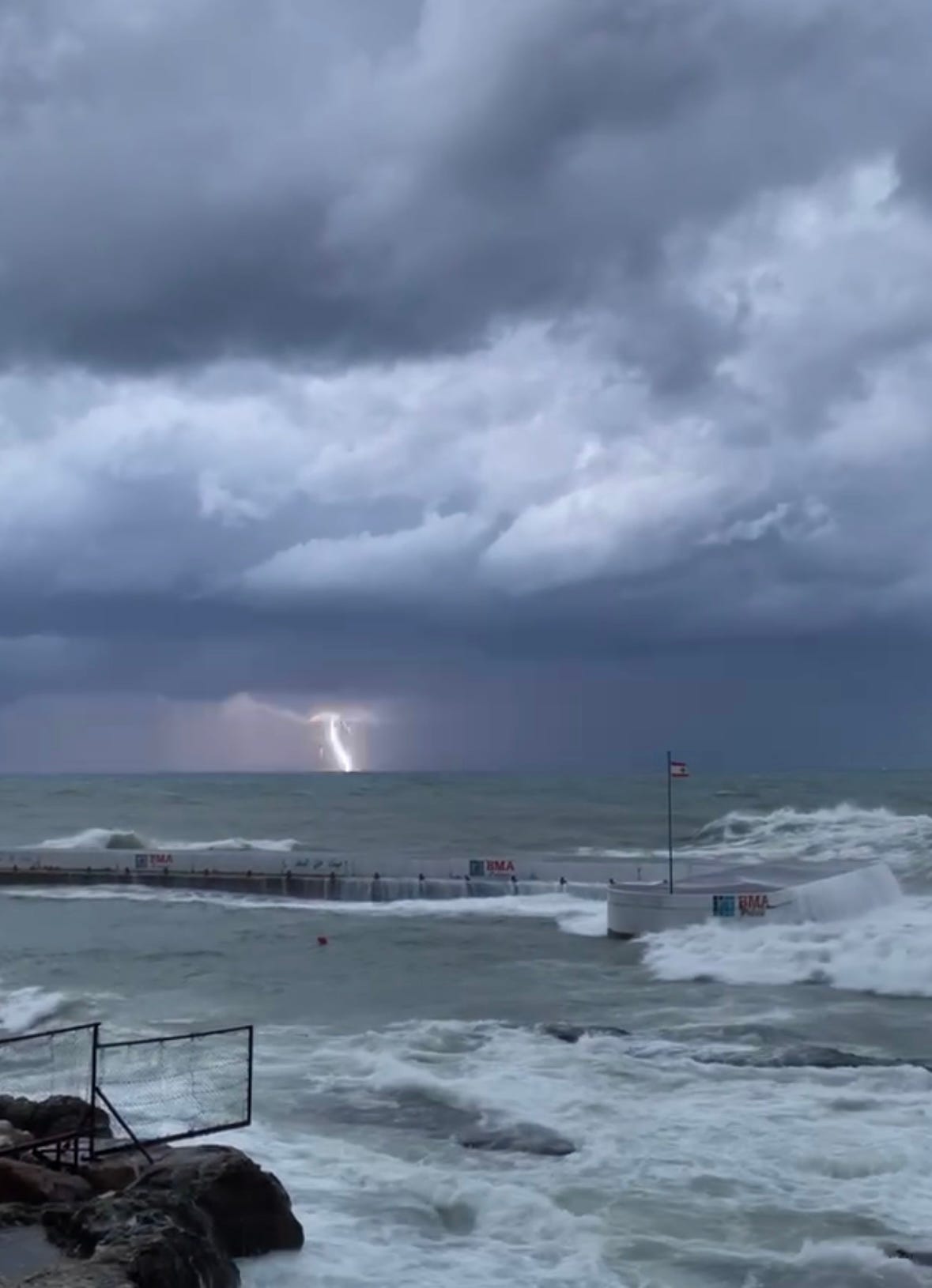
photo: Now that I’m an adult, I drive to the same coastline I used to watch from our balcony, only to do the very same thing.
I tried to expand my knowledge of clouds, their formations, and their functions using my little booklet. Some of the systems described in the booklet were not even found in Lebanon, but learning the basics, such as the cloud names, how to estimate if low-pressure fronts were approaching, became like a fun game with myself.
Between late September and the approach of spring, I spent a lot of time on the balcony, observing clouds and hunting for lightning sightings. When I started school, I realized that this interest of mine was not very common. But I always liked looking outside in winter, trying to estimate if it could rain with the approach of certain clouds. I found it very entertaining.
I recall a very cold winter day in February when I was about sixteen, second year of high school. I placed a bet with my geography teacher that in 15 to 20 minutes it would rain heavily, and the temperature would drop drastically. The students laughed because it had rained all night, and the sky seemed clear. But I could see another system approaching from above the sea, from the south, as most systems in Lebanon do. It was well-developed, stronger than the one from the night before. Within 20 to 25 minutes, we were sent home, and parents came to pick us up. That day, it snowed all the way down to around 400 meters above sea level, which is very rare in Lebanon. The joke of the day was that we would ski our way back home.
I can also recall my very first sighting of mammatus clouds. During lunch break at school, I tried to explain them to my peers, which to them seemed very strange. That day, these clouds even made it to the news with photos and videos. Mammatus clouds form when very cold air high above drops into warmer air below. The warmer air from below pushes upward, creating these rounded, pouch-like shapes hanging from the cloud base. Most of the time, they indicate either the approach of a system or the end of it. Seeing them for the first time felt unreal, like observing something otherworldly in the sky.
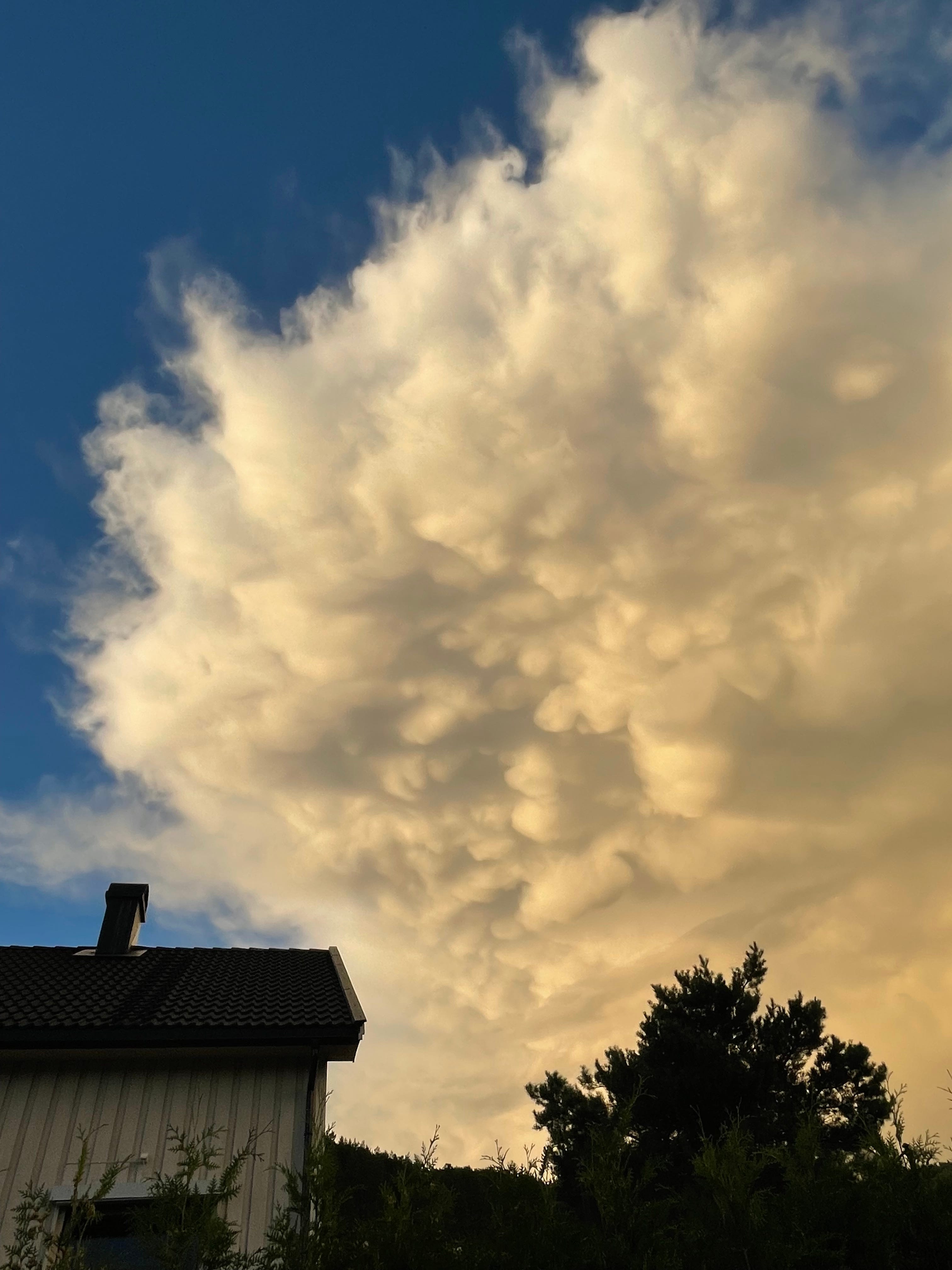
Photo: mammatus clouds on a rainy summer day in Norway.
All I know is, later on, when I unleashed my curiosity, being a climber seeking mountains and summits, I wanted to be closer to clouds. Reflecting now, I’m not sure if it’s just climbing itself that attracts me, or simply the desire to be closer to clouds, to be part of them, to touch them, to realize what I imagined as a kid. Perhaps it is the main motive for me, not the mountains, but just being closer to clouds.
A few weeks ago, I climbed with Lukas up to the summit of Mount Kazbek at 5054 meters. The weather was nearly perfect despite the very strong and cold winds. We saw the shadow of the mountain at sunrise. It was a beautiful view and a rare sight. I have had many summits up this mountain, but this one felt like no other. But something felt missing. I could not see a single cloud. I have always liked a sea of clouds when I am on top of a mountain. I like watching the clouds touch the mountain, become part of it, and then drift away, leaving me a little farther behind. Some sort of flirting game. That sensation is something I have always sought. These beautiful stand-alone clouds stuck on the flanks of mountains seem to be the most attractive type to me. That is the type I always want to be closer to.
I once went on a trail run by sunset in Mount Lebanon and I came back home to tell my aunt it was an out-of-reality run. It was foggy, but by sunset the clouds dispersed and came down the mountain to form a beautiful sea of clouds. For a while, because of the wind, some clouds popped up, emerging with the mountain and myself as one, then dropping down again. I told her it felt unreal being part of the mountain, the cloud, and the sky at sunset. She said I have such a unique relationship with the elements, intimate, perhaps spiritual, something only I can understand.
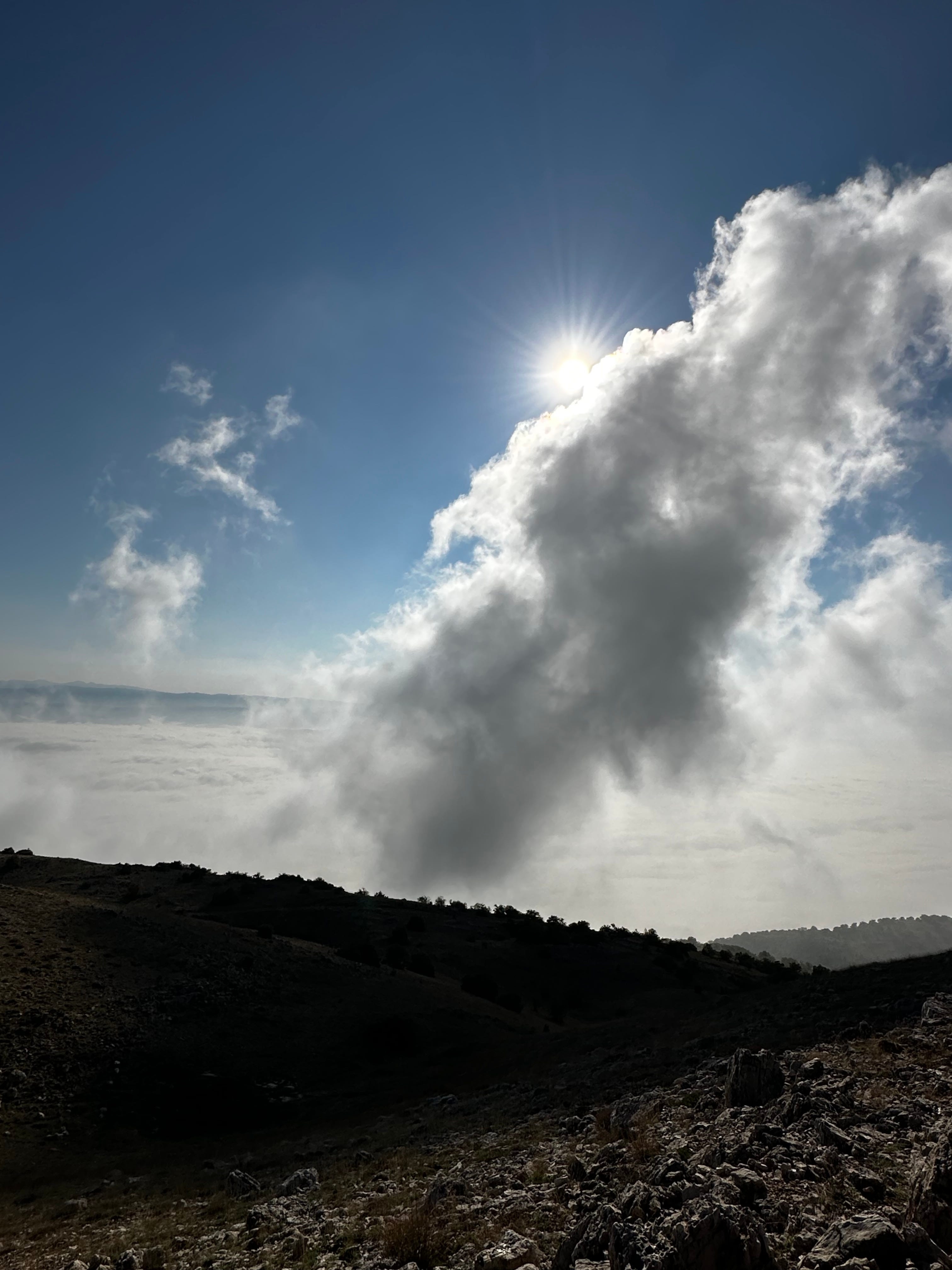
When spring ends in Lebanon, we see fewer clouds and warmer weather approaches. With it comes a seasonal depression of mine that is the opposite of the typical kind. I want my clouds, and I wait until September when I can meet them again in the mountains. That is when I can breathe, reflect, and find comfort. That is when I feel at peace and at home. And in fact, that is when I feel most alive and productive. Perhaps it is not just climbing, summits, routes, or trails that I seek. It is closer to clouds where I find peace and serenity.
Under the UK sky, at the southern shores, we set up our bivvy. The sun is gone, dew starts to form, and I’m listening to my brother’s excitement as he identifies animals in the velvet clouds.
It was a meditative read; thanks!
Such a beautiful poetic read , I feel the same about the gray weather but rarely appreciated the clouds.